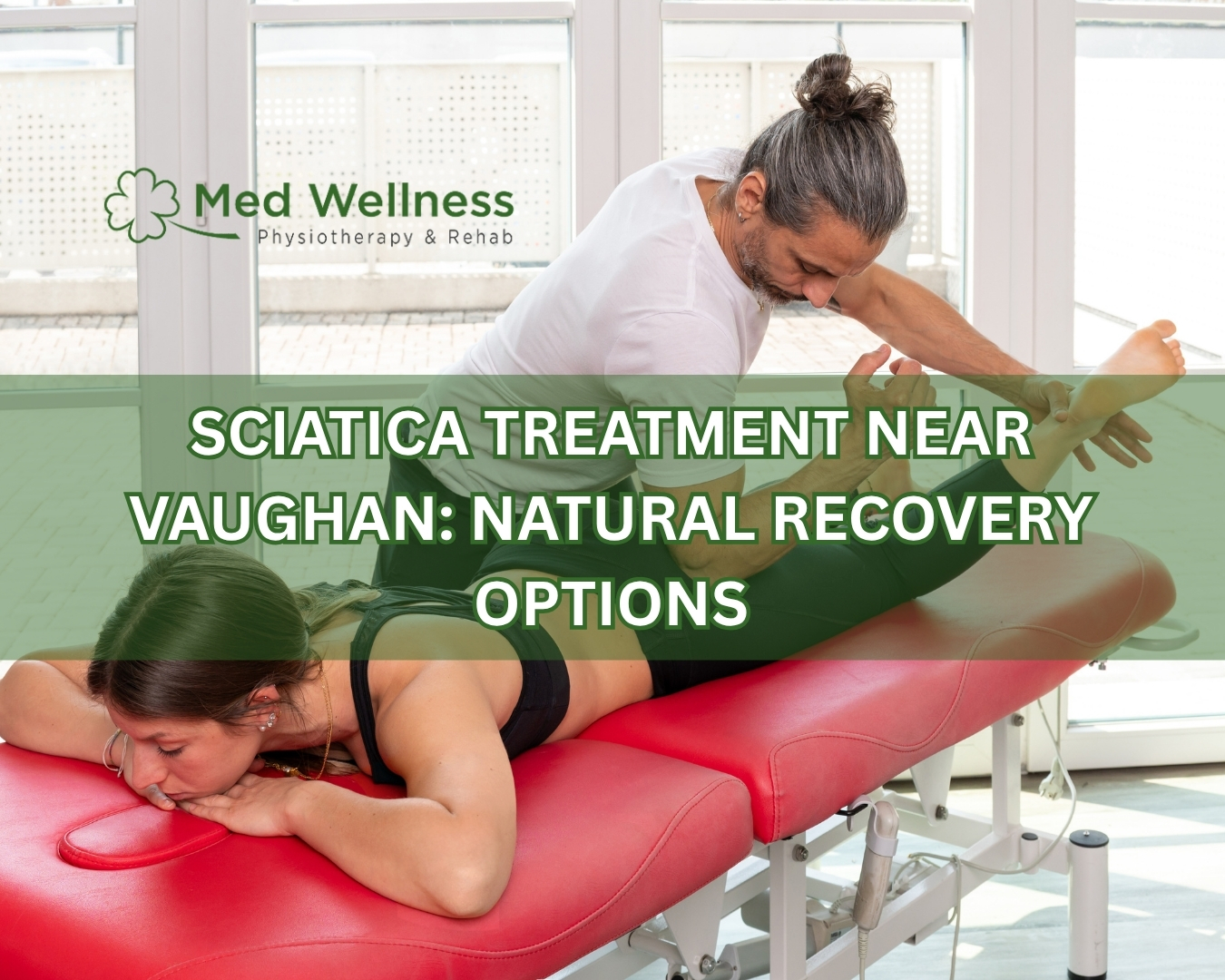
Sciatica pain can make simple daily activities extremely uncomfortable. Walking, sitting, standing, bending, or even sleeping may become difficult when the sciatic nerve becomes irritated or compressed. In many cases, the pain begins in the lower back and travels through the hips, buttocks, and legs.
Fortunately, surgery is not always necessary for recovery. Many individuals searching for sciatica treatment Vaughan services are now choosing non-surgical rehabilitation programs to improve mobility, reduce nerve irritation, and support natural healing safely.
At Med Wellness Physiotherapy and Rehab Centre, patients receive personalized rehabilitation programs designed to reduce sciatic nerve discomfort, improve flexibility, and restore movement naturally.
When surrounding muscles, spinal discs, or joints place pressure on the nerve, symptoms may gradually develop.
Common symptoms include:
In many situations, symptoms may worsen over time without proper rehabilitation and movement correction.
Several physical conditions and movement habits may contribute to sciatic nerve irritation.
For example, spinal disc irritation or bulging may place pressure on nearby nerves.
Additionally, sitting for long hours with poor posture may increase stress on the lower back and sciatic nerve.
Tight muscles in the hips, lower back, and legs may contribute to nerve irritation and restricted movement.
Meanwhile, repetitive lifting and physically demanding work may place excessive pressure on spinal structures.
Improper exercise technique and repetitive strain may increase the risk of lower back and nerve-related problems.
Understanding the root cause of sciatica is important because rehabilitation should address both symptoms and movement mechanics.
Many individuals ignore mild sciatic pain during the early stages. However, untreated nerve irritation may gradually increase and begin affecting mobility and physical function.
Early rehabilitation may help:
Consequently, seeking professional treatment early often improves recovery outcomes significantly.
Physiotherapy is one of the most effective non-surgical treatments for sciatic nerve rehabilitation. Instead of simply masking symptoms temporarily, physiotherapy focuses on restoring movement mechanics and improving spinal support.
At Med Wellness Physiotherapy and Rehab Centre, physiotherapists assess:
Based on the assessment, a personalized rehabilitation plan is developed according to the patient’s condition and recovery goals.
Physiotherapy for sciatica Vaughan programs may help:
Because every patient experiences sciatica differently, customized rehabilitation is essential for effective recovery.
Poor posture and spinal stress frequently contribute to sciatic nerve irritation. Therefore, spinal therapy Vaughan programs may help improve mobility, flexibility, and spinal alignment.
Benefits of spinal therapy may include:
Furthermore, improving spinal movement may help reduce pressure on surrounding nerves and tissues.
Stretching exercises are commonly included in sciatica rehabilitation programs because flexibility improvements may help reduce nerve irritation.
This stretch may help reduce lower back tension.
Tight hip muscles may contribute to sciatic nerve irritation.
Because flexibility improves gradually, exercises should always be performed gently and consistently.
Sciatica frequently causes surrounding muscles to become tight and restricted. Because of this, massage therapy is commonly combined with physiotherapy to improve rehabilitation outcomes.
Massage therapy may help:
In addition, reducing muscle tightness may improve comfort during rehabilitation exercises and daily movement.
Some patients experiencing chronic muscle tension and soft tissue irritation may benefit from shockwave therapy Vaughan treatments.
Shockwave therapy is a non-invasive treatment that uses acoustic sound waves to stimulate healing in injured tissues.
Shockwave therapy may help:
Since the treatment is non-surgical, many patients include shockwave therapy as part of their rehabilitation program.
Weak supporting muscles and poor movement habits often contribute to recurring sciatic nerve irritation. Therefore, rehabilitation programs frequently include strengthening and mobility exercises.
Exercise rehabilitation may help:
In many situations, strengthening supporting muscles significantly improves long-term recovery and mobility.
Healthy daily habits may support rehabilitation and reduce nerve irritation.
Changing positions regularly may reduce pressure on the lower back and sciatic nerve.
Good posture may reduce spinal stress during daily activities.
Stretching exercises may improve flexibility and mobility.
Gentle movement and walking may improve circulation and recovery.
Correct lifting mechanics may reduce lower back strain.
You should consider professional rehabilitation if:
Professional assessment can help identify nerve-related problems and guide effective rehabilitation treatment.
Yes. Physiotherapy may help reduce nerve irritation, improve mobility, and strengthen supporting muscles naturally.
Recovery time depends on the severity of symptoms, physical condition, and consistency with rehabilitation exercises.
In many cases, gentle walking may improve circulation and reduce stiffness during recovery.
Recovering from sciatica requires proper rehabilitation, movement therapy, and long-term support.
Med Wellness Physiotherapy and Rehab Centre provides physiotherapy, spinal therapy, massage therapy, shockwave therapy, and personalized rehabilitation programs for patients in Vaughan and Woodbridge.
Med Wellness Physiotherapy and Rehab Centre
110 Ansley Grove Rd, Woodbridge, ON L4L 3R1, Canada
Phone: +1 905-605-8889
Email: medwellnesscentre@gmail.com
Website: Med Wellness Physiotherapy and Rehab Centre
Booking an early assessment may help you reduce sciatic nerve pain, improve mobility, and return to daily activities more comfortably and confidently without surgery.