
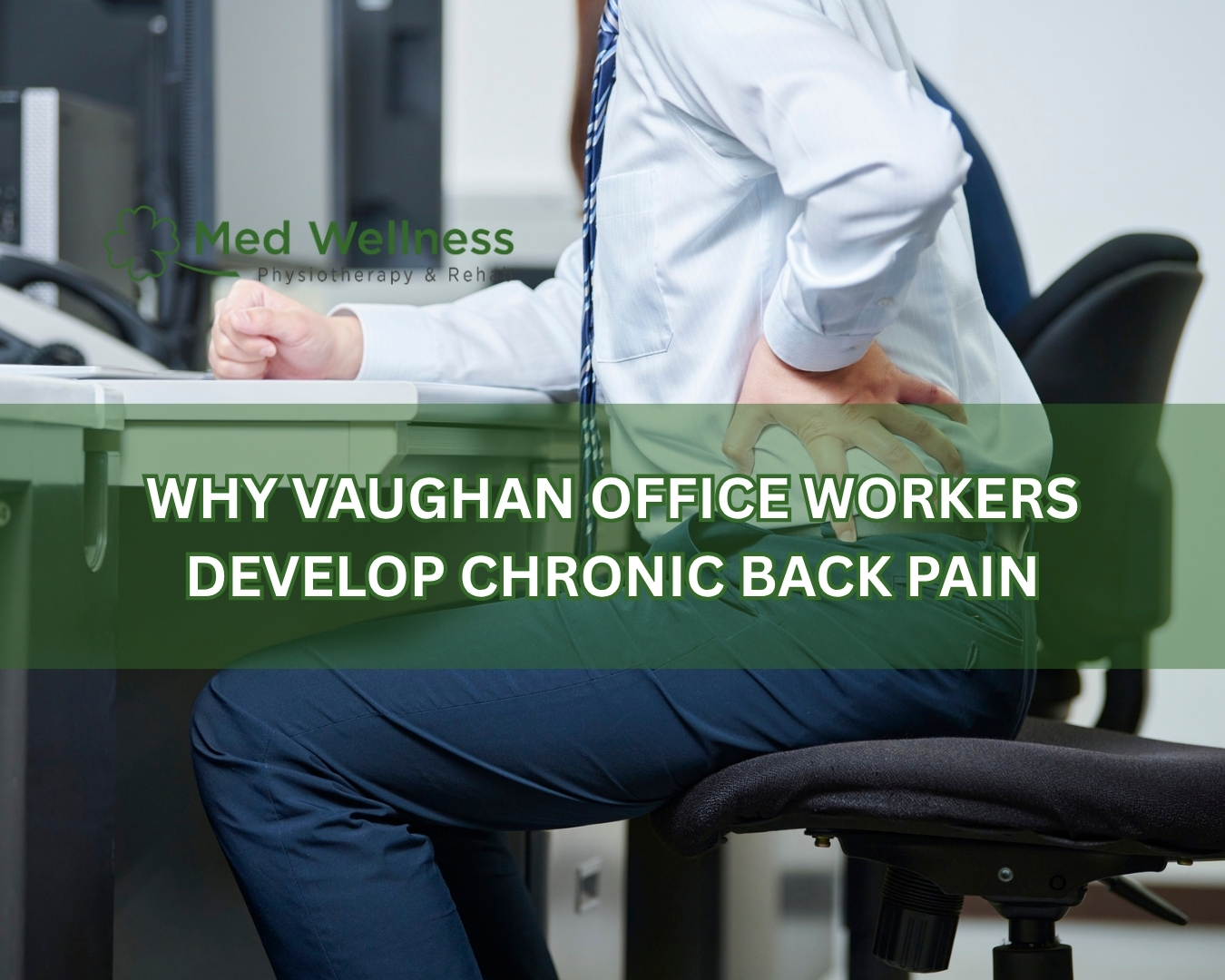
Chronic back pain has become one of the most common health problems among office workers in Vaughan and Woodbridge. Modern work environments often require people to spend long hours sitting at desks, using computers, attending virtual meetings, and remaining in static positions for most of the day.
Over time, these habits may place continuous stress on the spine, muscles, joints, and supporting tissues.
Many office workers experience:
What often begins as mild discomfort may gradually become chronic pain affecting work performance, sleep quality, exercise, and overall quality of life.
Fortunately, many posture-related back problems improve successfully through physiotherapy, posture correction therapy, stretching exercises, spinal rehabilitation, ergonomic improvements, and movement-based treatment programs.
At Med Wellness Physiotherapy and Rehab Centre in Vaughan, personalized rehabilitation programs help office workers improve posture, reduce pain, and support long-term spinal health naturally.
The human body is designed for regular movement, not prolonged sitting.
Long hours sitting may increase stress on:
Research shows prolonged sitting increases spinal compression and contributes to chronic lower back pain.
Office workers often remain seated for:
This lack of movement gradually affects spinal health and muscular balance.
Poor posture is one of the biggest contributors to office-related back pain.
Common posture problems include:
Poor posture increases stress on the spine and surrounding muscles over time.
Experts note that forward head posture and prolonged slouching significantly increase spinal strain.
Sitting for long periods often weakens:
Weak muscles provide less support for the spine, which may increase:
This is why many office workers experience worsening discomfort after long workdays.
Prolonged sitting keeps the hips bent for extended periods.
Over time, this may lead to:
Muscle tightness often contributes to poor posture and reduced movement quality.
Stretching exercises are commonly recommended to improve flexibility and reduce stiffness.
Office work often limits regular movement throughout the day.
Reduced movement may contribute to:
Research suggests frequent movement breaks help reduce spinal stress and muscular tension.
Computer and smartphone use commonly contribute to “tech neck.”
This occurs when:
Over time, this may lead to:
Desk workers are especially vulnerable because of prolonged screen exposure.
Many office workers ignore mild discomfort initially.
Unfortunately, repetitive daily stress may gradually lead to:
Pain often becomes more noticeable after months or years of repetitive posture strain.
Early rehabilitation may help prevent worsening symptoms.
Symptoms vary depending on posture, mobility, and muscle condition.
Common symptoms include:
Some individuals also experience tingling or numbness in the arms or legs.
Physiotherapy is one of the most effective non-surgical treatments for posture-related pain.
Treatment focuses on:
A physiotherapist evaluates:
A personalized rehabilitation plan is then developed according to the patient’s work habits and symptoms.
Stretching exercises help reduce muscular tension caused by prolonged sitting.
Important areas often include:
Stretching may help:
Regular movement is important because prolonged sitting increases muscular tightness.
The chin tuck exercise helps improve neck posture.
Benefits may include:
This exercise is commonly included in posture correction rehabilitation programs.
Tight hip flexors commonly contribute to lower back strain.
This stretch may help:
Weak core muscles increase spinal stress during sitting.
Strengthening exercises may help:
Physiotherapy programs commonly focus on:
Strong supporting muscles help reduce long-term spinal stress.
Proper workstation setup may significantly reduce posture-related pain.
Helpful ergonomic strategies include:
Experts recommend frequent posture adjustments throughout the workday.
Sitting continuously for long periods increases muscular fatigue and spinal compression.
Experts recommend:
Movement helps:
Regular movement breaks are strongly recommended for office workers.
Desk workers often develop stiffness in:
Spinal therapy may help:
Spinal rehabilitation is often combined with posture correction exercises for better long-term results.
Massage therapy may help office workers experiencing:
Benefits may include:
Massage therapy is commonly integrated into posture rehabilitation programs.
Healthy movement habits play a major role in reducing chronic back pain.
Helpful strategies include:
Consistency with movement habits often improves long-term spinal health significantly.
You should seek physiotherapy if you experience:
Early rehabilitation often improves recovery outcomes and helps prevent chronic pain progression.
Several clinics in Vaughan and Woodbridge provide physiotherapy and posture rehabilitation services, including:
These clinics provide physiotherapy, posture correction therapy, spinal rehabilitation, ergonomic education, and chronic pain management services throughout Vaughan and Woodbridge.
Many office workers throughout Vaughan and Woodbridge trust Med Wellness Physiotherapy and Rehab Centre for personalized posture rehabilitation and chronic pain management.
Services include:
Treatment programs are designed to improve mobility, reduce pain, improve posture, and support long-term spinal health naturally.
📍 110 Ansley Grove Rd, Woodbridge, ON L4L 3R1, Canada
📞 +1 905-605-8889
📧 medwellnesscentre@gmail.com
Chronic back pain has become increasingly common among office workers due to prolonged sitting, poor posture, reduced movement, and repetitive daily habits. Without proper treatment, posture-related spinal stress may gradually lead to chronic pain and reduced mobility.
If you are searching for chronic back pain treatment in Vaughan or Woodbridge, personalized rehabilitation and professional physiotherapy may help improve comfort, mobility, posture, and long-term wellness safely.