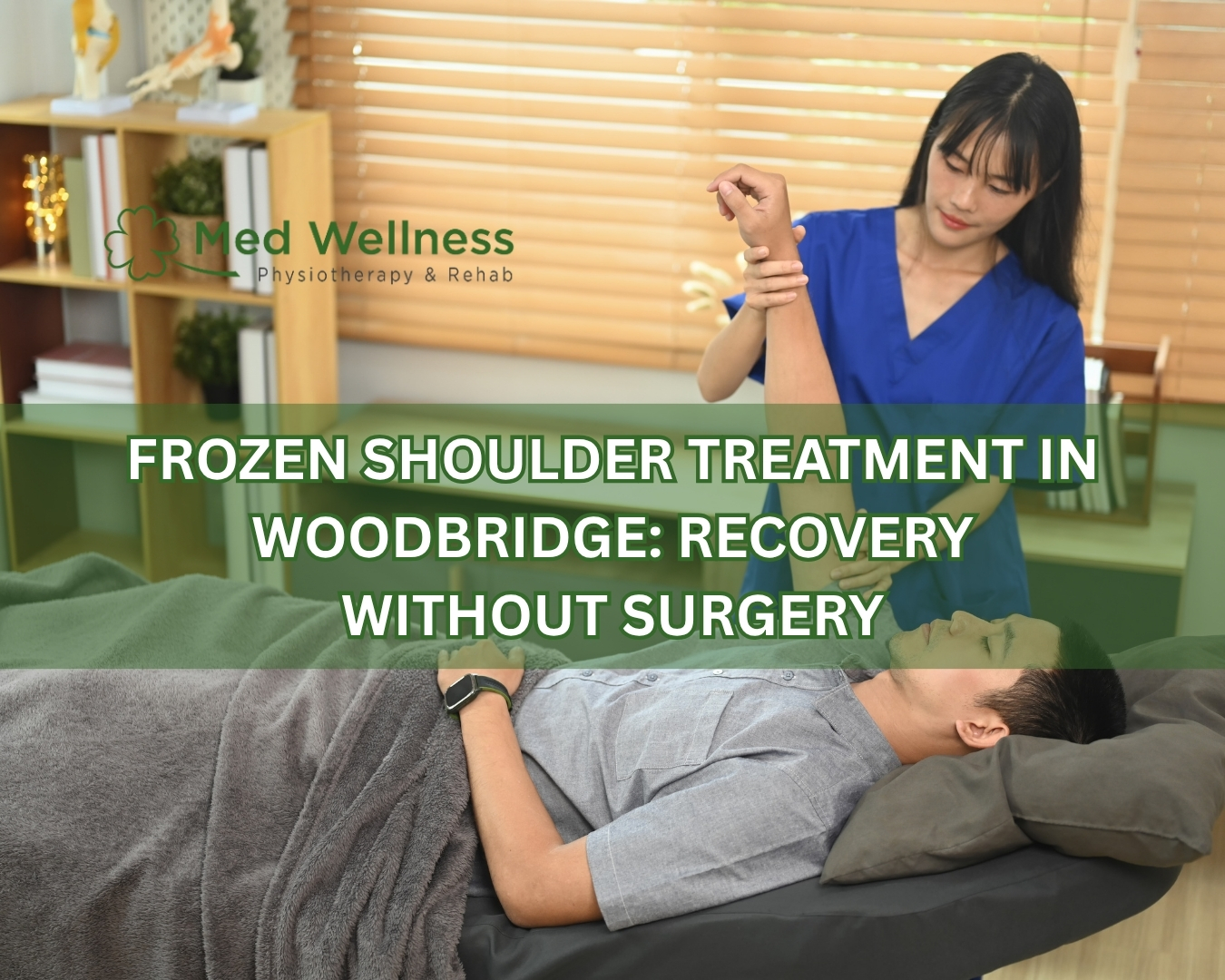
Frozen shoulder, also known as adhesive capsulitis, is a painful condition that gradually limits shoulder movement and flexibility. Many people in Woodbridge and Vaughan experience increasing shoulder stiffness that makes simple daily activities difficult, including:
Frozen shoulder often develops slowly over time and may worsen if mobility becomes increasingly restricted.
Without proper rehabilitation, the condition may significantly affect:
Fortunately, many cases improve successfully through non-surgical rehabilitation including physiotherapy, stretching exercises, mobility rehabilitation, posture correction, and movement-based treatment programs.
At Med Wellness Physiotherapy and Rehab Centre in Woodbridge, personalized rehabilitation programs help patients reduce shoulder pain, improve mobility, and support long-term recovery naturally.
Frozen shoulder occurs when the connective tissue surrounding the shoulder joint becomes irritated, stiff, and restricted.
Over time, this may lead to:
Research describes frozen shoulder as a condition involving progressive pain and restriction of shoulder joint mobility.
Symptoms often develop gradually.
Common symptoms include:
Many individuals notice symptoms worsening over time if shoulder movement becomes increasingly limited.
Frozen shoulder typically progresses through different stages.
During this phase:
During this stage:
During recovery:
Recovery may take several months depending on severity and rehabilitation consistency.
The exact cause is not always clear.
However, frozen shoulder may develop after:
Research suggests reduced movement following pain or injury may contribute to joint stiffness progression.
Certain individuals are more vulnerable to frozen shoulder.
Risk factors may include:
Women appear to experience frozen shoulder more frequently than men.
Ignoring shoulder stiffness may lead to:
Early physiotherapy intervention often improves mobility and recovery outcomes.
Physiotherapy is one of the most effective non-surgical treatments for frozen shoulder.
Treatment focuses on:
A physiotherapist evaluates:
A personalized rehabilitation program is then developed according to the patient’s symptoms and mobility restrictions.
Research supports physiotherapy and mobility exercises for improving frozen shoulder recovery.
Important areas often include:
Consistent stretching is often necessary because frozen shoulder recovery usually happens gradually.
The pendulum exercise is commonly recommended during early rehabilitation.
Benefits may include:
This exercise helps improve shoulder flexibility.
Benefits may include:
Wall climbing exercises help gradually improve shoulder movement.
Benefits may include:
Research supports gradual mobility exercises during frozen shoulder rehabilitation.
Many people avoid moving the shoulder because of pain.
However, complete immobilization may worsen stiffness.
Controlled movement and gradual rehabilitation often help improve:
Movement should remain gentle and guided according to pain tolerance.
As mobility improves, strengthening exercises become important.
Strengthening may help:
Physiotherapy programs often include:
Strong supporting muscles help improve long-term shoulder function.
Poor posture commonly contributes to shoulder dysfunction.
Forward head posture and rounded shoulders may increase stress on the shoulder joint.
Posture correction therapy may help:
Desk workers commonly benefit from posture rehabilitation during frozen shoulder recovery.
Upper back stiffness may affect shoulder movement mechanics.
Spinal therapy may help:
Spinal rehabilitation is often integrated into shoulder rehabilitation programs.
Massage therapy may help reduce:
Benefits may include:
Massage therapy is commonly combined with physiotherapy rehabilitation.
Some patients with chronic tendon irritation or calcific shoulder conditions may benefit from shockwave therapy.
Shockwave therapy may help:
This non-invasive treatment is often combined with physiotherapy exercises for improved recovery support.
Healthy movement habits improve rehabilitation outcomes.
Helpful strategies include:
Consistency is extremely important because frozen shoulder recovery often happens gradually over time.
You should seek physiotherapy if you experience:
Early treatment often improves mobility and long-term recovery outcomes.
Several clinics in Vaughan and Woodbridge provide physiotherapy and shoulder rehabilitation services, including:
These clinics provide physiotherapy, mobility rehabilitation, chronic pain management, shoulder rehabilitation, and posture correction services throughout Vaughan and Woodbridge.
Patients throughout Vaughan and Woodbridge trust Med Wellness Physiotherapy and Rehab Centre for personalized rehabilitation and chronic pain management.
Services include:
Treatment programs are designed to improve mobility, reduce pain, restore shoulder movement, and support long-term recovery naturally.
📍 110 Ansley Grove Rd, Woodbridge, ON L4L 3R1, Canada
📞 +1 905-605-8889
📧 medwellnesscentre@gmail.com
Frozen shoulder can significantly affect mobility, sleep quality, work performance, and everyday comfort. Without proper treatment, progressive stiffness may limit shoulder movement and reduce overall function.
If you are searching for frozen shoulder treatment in Woodbridge or Vaughan, personalized rehabilitation and professional physiotherapy may help improve movement, comfort, and long-term shoulder health safely.