Chronic pain can affect every part of daily life—from walking and working to sleeping and exercising. Many people in Vaughan and Woodbridge live with ongoing pain caused by:
When traditional treatments don’t provide enough relief, many patients start searching for:
The short answer is:
However, it’s important to understand:
This guide explains the science, benefits, limitations, and local treatment options for shockwave therapy in Vaughan.
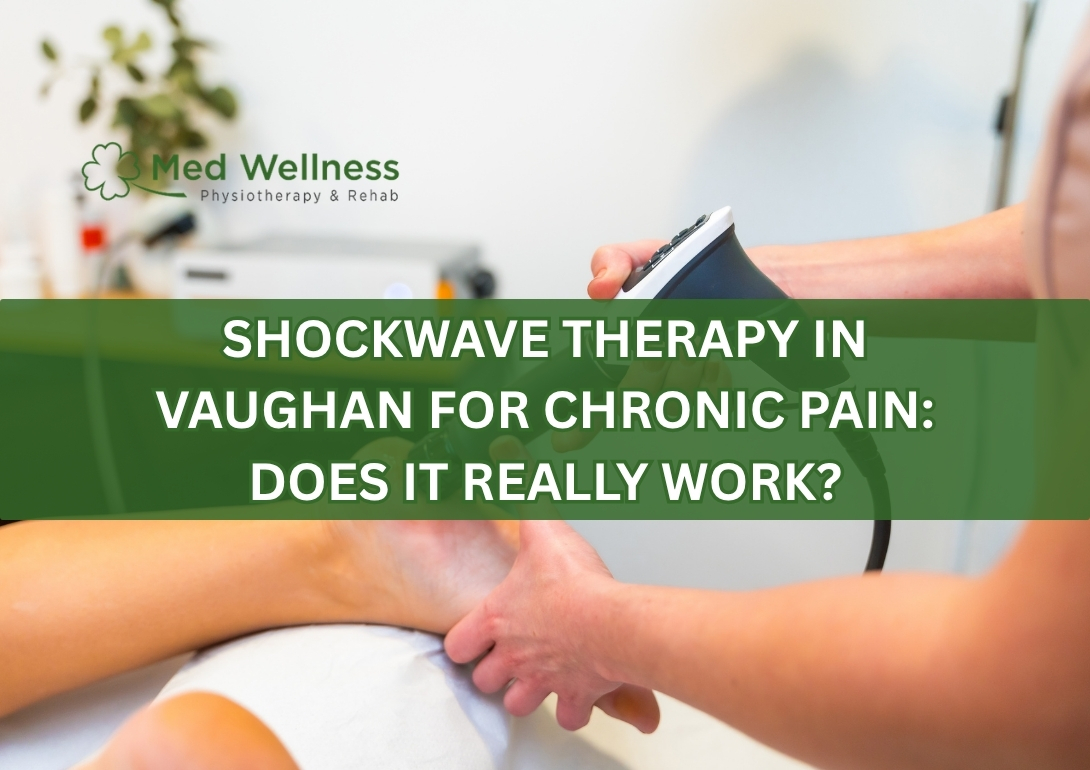
Shockwave therapy, also called
uses high-energy acoustic waves to stimulate healing in injured tissues.
Unlike surgery or injections, shockwave therapy is:
✔ non-invasive,
✔ drug-free,
✔ and typically performed in-office.
According to the
American Physical Therapy Association (APTA) ESWT advisory, ESWT uses sound waves to reduce pain and promote tissue healing.
Shockwave therapy works by stimulating:
This is especially helpful for chronic conditions where tissues have stopped healing properly.
Shockwave therapy is most commonly used for chronic musculoskeletal pain conditions.
Research increasingly supports ESWT for tendon-related and soft tissue conditions.
The evidence suggests:
Recent systematic reviews and meta-analyses show ESWT may improve:
For example:
Shockwave therapy is not magic.
Not every patient responds the same way, and research also shows results can vary depending on:
Some reviews found ESWT works best as part of a broader rehabilitation plan rather than as a standalone solution.
A broader 2025 review on non-surgical back pain treatments also noted that no single treatment works perfectly for every patient.
Modern rehabilitation clinics rarely use shockwave therapy alone.
Research suggests combining ESWT with guided rehabilitation often produces better outcomes than passive treatment alone.
During treatment:
Patients may feel:
Most people return to normal daily activity immediately afterward.
Recovery depends on:
Some patients notice improvement quickly, while others improve gradually over several weeks.
Research also suggests healing effects may continue even after treatment ends.
Shockwave therapy may not be suitable for:
A physiotherapist or healthcare professional should evaluate whether ESWT is appropriate for your condition.
Most chronic conditions require multiple sessions plus rehabilitation.
Shockwave helps healing, but movement rehabilitation is still important.
ESWT works best for specific musculoskeletal and tendon-related conditions.
Most patients tolerate treatment well, although mild discomfort is normal.
Several rehabilitation clinics near Vaughan offer shockwave therapy combined with physiotherapy and rehabilitation services.
These clinics commonly provide treatment for:
Located in Woodbridge, this clinic offers:
📍 Address: 110 Ansley Grove Rd, Woodbridge, ON L4L 3R1, Canada
📞 Phone: +1 905-605-8889
🌐 Website: https://medwellnesscentre.ca/
Follow the recommended session schedule.
Movement therapy improves long-term outcomes.
Daily habits strongly affect recovery.
Allow tissues time to heal properly.
Gentle movement usually supports recovery better than complete rest.
Shockwave therapy is not a miracle cure—but for many chronic pain conditions, it can be an effective non-surgical treatment option.
The strongest evidence supports its use for:
✔ tendon injuries,
✔ chronic soft tissue pain,
✔ plantar fasciitis,
✔ shoulder pain,
✔ and chronic musculoskeletal conditions.
For many Vaughan patients, the best results come from combining:
If chronic pain is limiting your daily activities, professional assessment and treatment at clinics like
Med Wellness Physiotherapy and Rehab Centre in Vaughan | Massage therapy in Vaughan | shockwave therapy may help support recovery and improve mobility safely.